What is lasagna?
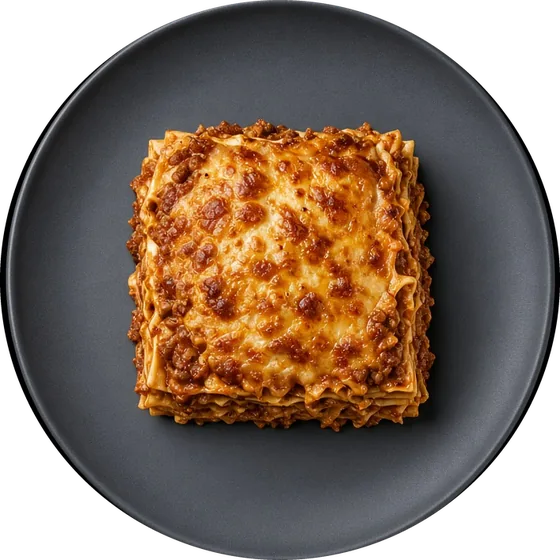
Lasagna is an Italian dish of pasta sheets stacked in layers with a filling, usually ragù, béchamel and Parmesan cheese, and baked. The word also names each individual pasta sheet.[2][3][4]
What is in lasagna?
- Egg pasta sheets; in Bologna, green, with spinach in the dough
- Bolognese ragù
- Béchamel: flour, whole milk, butter, salt and nutmeg
- Parmigiano Reggiano, grated at the last moment
- In Naples: meatballs, ricotta and caciocavallo or mozzarella
Where does lasagna come from?
The ancient Romans ate lagane (laganum), a sheet of flour and water. The poet Horace mentions a simple meal of "leeks, chickpeas and lagane", and the Apicius cookbook has baked tarts layering lagane with a meat and fish filling. Exactly what that dough was like is unknown.[1][3]
In the Middle Ages, the sheets were cooked in broth and served with cheese and spices. Friar Salimbene de Adam of Parma wrote in a 1284 chronicle that he had never seen anyone eat lasagna with cheese as eagerly as another friar. The Liber de coquina, from the Angevin court in Naples, describes a "lasagna tart" for noble tables.[1][3]
Béchamel and tomato came late. According to the Michelin Guide, béchamel, of French origin, was added around the 18th century, and the first tomato lasagna appears in 1881, in a Neapolitan book by Francesco Palma. Gambero Rosso notes that when baked lasagna became fashionable in Italy, ragù did not yet exist in Bologna; by the early 20th century it was made with ragù, béchamel and Parmesan.[3][1]
Types of lasagna
Bologna: green lasagna, with spinach in the dough. The Accademia Italiana della Cucina certified the recipe on May 28, 2003, and it was registered by notarial deed with the Bologna Chamber of Commerce on July 4, 2003. It calls for at least six layers.[4]
Naples: with meatballs, meat sauce, ricotta and caciocavallo, or provola or mozzarella. The first books to describe it, such as Ippolito Cavalcanti's of 1837, tie it to Carnival.[1][3]
Marche: vincisgrassi, with chicken giblets. Its ancestor, "princisgras", appears in a 1779 cookbook by Antonio Nebbia.[1][3]
Liguria: with pesto. Veneto: with Treviso radicchio instead of spinach.[3]
Other names
Italian mostly uses the plural, lasagne, for the baked dish. The Accademia della Crusca dictionary listed "lasagne" in 1612 and added the singular in the 18th century. The word's origin is uncertain: proposals include Latin lasanum, "pot"; losanga, "rhombus", for the shape of the portions; or an Arabic word for an almond sweet.[2][1]
When is lasagna eaten?
It is a holiday and Sunday dish: the Michelin Guide calls it a "special festive dish", and some restaurants serve it only on Sundays and on holiday menus. In Naples it is associated with Carnival.[3][1]
Did you know?
In the Middle Ages, the gluttonous friar stuffing himself with lasagna became a literary cliché.[1]
The lasagna tart in the Liber de coquina was ringed with sausages like a city wall and topped with a pasta serpent fighting a dove.[1]
Frequently asked questions
What is lasagna?
Lasagna is an Italian dish of pasta sheets stacked in layers with a filling, usually ragù, béchamel and Parmesan cheese, and baked. The word also names each individual pasta sheet.
What are the ingredients of lasagna?
Egg pasta sheets; in Bologna, green, with spinach in the dough; Bolognese ragù; Béchamel: flour, whole milk, butter, salt and nutmeg; Parmigiano Reggiano, grated at the last moment; In Naples: meatballs, ricotta and caciocavallo or mozzarella.
Where is lasagna from?
The ancient Romans ate lagane (laganum), a sheet of flour and water. The poet Horace mentions a simple meal of "leeks, chickpeas and lagane", and the Apicius cookbook has baked tarts layering lagane with a meat and fish filling. Exactly what that dough was like is unknown.
When is lasagna eaten?
It is a holiday and Sunday dish: the Michelin Guide calls it a "special festive dish", and some restaurants serve it only on Sundays and on holiday menus. In Naples it is associated with Carnival.
Sources
- Gambero Rosso: La storia delle lasagne, dalle origini nell'antica Roma
- Linkiesta (respuesta de la Accademia della Crusca): Si dice «lasagna» o «lasagne»? Risponde l'Accademia della Crusca
- Guía Michelin (Italia): Sua maestà la lasagna: dove gustarla secondo la Guida Michelin
- Bologna Welcome (turismo oficial de Bolonia): Lasagne verdi alla bolognese
Researched and checked on October 14, 2026. Legends and disputed claims are marked as such in the text. How we work
Other dishes
What is an empanada? · What is pizza? · What is a salad? · What is a Spanish-style fried egg? · What is gravy? · What is bacalao a la vizcaína? · What is eggnog? · What is turrón? · What is fruitcake? · What is arroz con leche? · all