What is pabellón criollo?
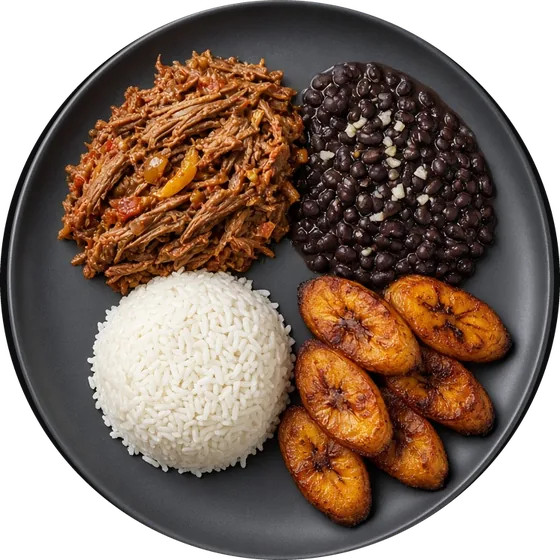
Pabellón criollo is Venezuela's national dish: white rice, shredded beef and black beans (caraotas), served side by side on the same plate, usually with slices of fried ripe plantain.[1][3]
What is in pabellón criollo (Venezuelan plate)?
- White rice
- Shredded stewed beef
- Refried black beans (caraotas)
- Slices of fried ripe plantain
- Sometimes: avocado, a fried egg or grated white cheese
Where does pabellón criollo (Venezuelan plate) come from?
It has no known date or creator. Food historian Rafael Cartay estimates it was born in Caracas between the late 19th century and the first decade of the 20th. Its parts were already served separately: in 1886 the Caracas restaurant El Vapor offered them two at a time, but, as José Rafael Lovera notes, it was not yet a single dish.[1][2]
A popular version says it was born in colonial times from leftovers eaten by enslaved people. It is a belief without documents: Cartay does not find it in Venezuela's first recipe book, from 1861, or in Tulio Febres Cordero's, from 1899.[3][4][1]
From 1916, when Francisco Pimentel (Job Pim) wrote the poem "Canto al Pabellón" about it, the Caracas press began to mention it often.[1]
Types of pabellón criollo (Venezuelan plate)
Con barandas ("with railings"): with the plantain slices, which were added over time to the rice, beef and beans.[1][2]
A caballo ("on horseback"): with a fried egg on top.[5]
Some people add grated white cheese to the beans, or use baked or green plantain instead of fried ripe slices.[4][3]
Other names
It was first called "pabellón caraqueño" (Caracas-style). Around 1910-1920, in the era of criollismo, it became "pabellón criollo". "Pabellón" also means flag.[1][2]
When is pabellón criollo (Venezuelan plate) eaten?
It is an everyday meal, eaten all year round, unlike the hallaca, which is for Christmas. It also appears on restaurant menus and at celebrations.[2][3]
Did you know?
It is often read as a symbol of mixed heritage: white rice for the Spanish, black beans for the African and beef for the Indigenous. Some authors downplay this reading; Cartay considers it valid.[1][2][3]
In Job Pim's poem, fried beans are called "negritas" and half beans, half rice is called "medioluto" (half-mourning).[2]
Frequently asked questions
What is pabellón criollo?
Pabellón criollo is Venezuela's national dish: white rice, shredded beef and black beans (caraotas), served side by side on the same plate, usually with slices of fried ripe plantain.
What are the ingredients of pabellón criollo (Venezuelan plate)?
White rice; Shredded stewed beef; Refried black beans (caraotas); Slices of fried ripe plantain; Sometimes: avocado, a fried egg or grated white cheese.
Where is pabellón criollo (Venezuelan plate) from?
It has no known date or creator. Food historian Rafael Cartay estimates it was born in Caracas between the late 19th century and the first decade of the 20th. Its parts were already served separately: in 1886 the Caracas restaurant El Vapor offered them two at a time, but, as José Rafael Lovera notes, it was not yet a single dish.
When is pabellón criollo (Venezuelan plate) eaten?
It is an everyday meal, eaten all year round, unlike the hallaca, which is for Christmas. It also appears on restaurant menus and at celebrations.
Sources
- Revista de Gastronomía y Cocina (Rafael Cartay, 2024): País y Nación: El Pabellón Criollo
- Agroalimentaria, Universidad de Los Andes (Rafael Cartay, 2015): Una nación también se construye desde el plato
- Diario Primicia (Venezuela): Pabellón criollo: gastronomía con historia venezolana
- Revista Estampas (Venezuela): Hablemos de nuestro pabellón criollo
- Directo al Paladar: Receta de pabellón criollo, el plato nacional de Venezuela
Researched and checked on October 14, 2026. Legends and disputed claims are marked as such in the text. How we work
Other dishes
What is a chivito? · What is an arepa? · What is feijoada? · What is lomo saltado? · What is a milanesa? · What is ceviche? · What is asado de tira? · What is pozole? · What is pan de muerto? · What is a tamale? · all