What is pan de muerto?
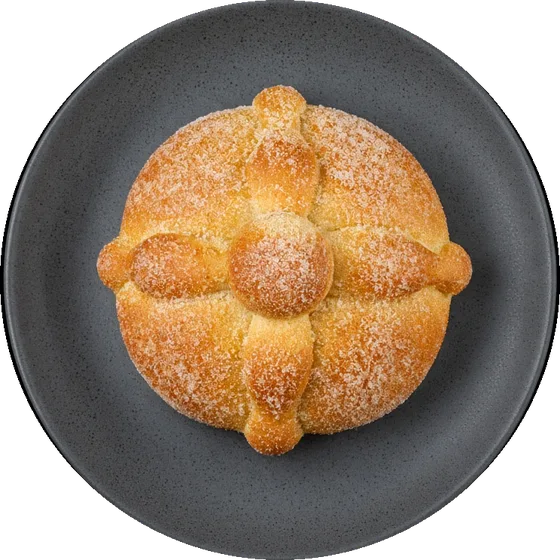
Pan de muerto ("bread of the dead") is a sweet wheat bread placed on Day of the Dead altars in Mexico and eaten around November 1 and 2.[1][2]
What is in Pan de muerto?
- Wheat flour, yeast, sugar and salt
- Milk, eggs and butter
- Vanilla and cinnamon
- Orange blossom water and orange zest
- Sugar on top, white or pink; in some places, sesame seeds
Where does Pan de muerto come from?
According to historians cited by the Mexican government, it has pre-Hispanic roots but took its current form in the colonial era, when wheat and sugar arrived. Ancient ritual breads included the papalotlaxcalli ("butterfly bread") and tzoalli, made of amaranth and honey.[1][3]
It also has a Spanish root: in León, Aragon and Castile, sweets imitating relics, the "saints' bones", were made.[4]
There is a legend about a heart offered to the gods that the Spanish supposedly replaced with bread: it is only a legend, without documentary support.[6]
Types of Pan de muerto
Central Mexico: round and covered in sugar. Michoacán: dark and shiny, nicknamed "rubber bread". Oaxaca: egg-yolk bread.[1]
Some are shaped like people or animals: regaños in Oaxaca, "muertes" in the State of Mexico, rabbits and "souls" in Guanajuato, tlacotonales in Puebla.[2][3]
When is Pan de muerto eaten?
It goes on altars on November 1, devoted to children, and November 2, All Souls' Day.[3]
Did you know?
The ball on top represents the skull and the crossed strips, the "canillas", the bones.[3][2]
Frequently asked questions
What is pan de muerto?
Pan de muerto ("bread of the dead") is a sweet wheat bread placed on Day of the Dead altars in Mexico and eaten around November 1 and 2.
What are the ingredients of Pan de muerto?
Wheat flour, yeast, sugar and salt; Milk, eggs and butter; Vanilla and cinnamon; Orange blossom water and orange zest; Sugar on top, white or pink; in some places, sesame seeds.
Where is Pan de muerto from?
According to historians cited by the Mexican government, it has pre-Hispanic roots but took its current form in the colonial era, when wheat and sugar arrived. Ancient ritual breads included the papalotlaxcalli ("butterfly bread") and tzoalli, made of amaranth and honey.
When is Pan de muerto eaten?
It goes on altars on November 1, devoted to children, and November 2, All Souls' Day.
Sources
- Gobierno de México (SRE): Pan de muerto, a delicious tradition
- UAEH (Vargas Muñoz y García Gómez): El pan de muerto
- Expansión: ¿Cuál es el origen del pan de muerto?
- El Financiero (Sonya Santos): Los huesos del pan de muerto
- Antropología, Boletín del INAH (1987): Panes de ofrenda
- Vanguardia: Historia del pan de muerto, una leyenda de azúcar y sangre
Researched and checked on October 14, 2026. Legends and disputed claims are marked as such in the text. How we work
Other dishes
What is pozole? · What is a tamale? · What is mole poblano? · What is a burrito? · What is champurrado? · What is atole? · What is Mexican hot chocolate? · What is calabaza en tacha? · What is Mexican Christmas apple salad? · What is Mexican Christmas ponche? · all