What are enchiladas?
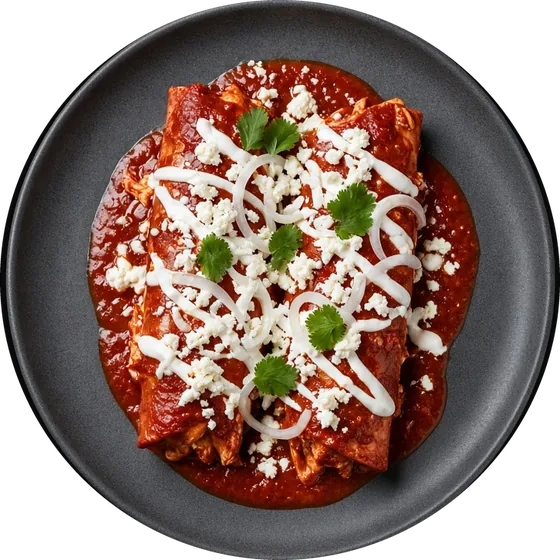
Enchiladas are corn tortillas dipped in chili sauce, filled and usually rolled. They are a Mexican antojito (snack dish), and the name comes from "enchilar": to season with chili.[1][2][3]
What is in enchiladas?
- Corn tortillas
- Red sauce of guajillo, ancho or cascabel chiles, or green tomatillo sauce
- Filling: chicken, pork, cheese, beans or egg
- On top: queso fresco, cotija or manchego cheese, cream and onion
Where does enchiladas come from?
They come from the tortilla, which is pre-Hispanic. In the 16th century, Friar Bernardino de Sahagún described chili-dipped tortillas sold at Mexica markets, filled with beans, meat and corn. History Today magazine credits the Mexica with the first "true" enchilada.[1][3]
Bernal Díaz del Castillo wrote that Moctezuma was brought tortillas "cooked with eggs". History Today considers it the oldest European description, though short on detail. After the Spanish conquest, cheese, pork and chicken were added.[1]
The first Mexican cookbook, from 1831, already had two enchilada recipes, and the phrase "tortillas enchiladas" is recorded in 1861. According to Vanguardia, some historians say Hidalgo, Guerrero and Morelos ate them on their travels around the country.[1][2][3]
Types of enchiladas
Suizas ("Swiss"): chicken, green sauce, cream and melted cheese. Their origin is disputed. Saveur says a Sanborns chef created them in 1950. Vanguardia and Mexico News Daily tell another story: the family of Emperor Maximilian's butler supposedly served them at Café Imperial in Mexico City. There is nothing Swiss about them: the name is explained by the dairy or by a resemblance to the snowy Alps.[3][4][5]
Mineras (Guanajuato): the story goes that wives waited outside the mines for their husbands with tortillas filled with cheese and onion and covered in guajillo chile.[3]
United States: after the annexation of Texas and the Southwest in the mid-19th century, they became workers' food and helped lay the groundwork for Tex-Mex. In New Mexico they are layered, not rolled.[1][2]
When is enchiladas eaten?
They are an everyday antojito. Enchiladas suizas are a classic at Sanborns, a chain that now has 129 restaurants in Mexico.[3][4]
Did you know?
By 1821, when Mexico became independent, enchiladas were already described as the closest thing to a national dish.[1]
In English, "the whole enchilada" means "everything", and it has been recorded since 1965.[2]
Frequently asked questions
What are enchiladas?
Enchiladas are corn tortillas dipped in chili sauce, filled and usually rolled. They are a Mexican antojito (snack dish), and the name comes from "enchilar": to season with chili.
What are the ingredients of enchiladas?
Corn tortillas; Red sauce of guajillo, ancho or cascabel chiles, or green tomatillo sauce; Filling: chicken, pork, cheese, beans or egg; On top: queso fresco, cotija or manchego cheese, cream and onion.
Where is enchiladas from?
They come from the tortilla, which is pre-Hispanic. In the 16th century, Friar Bernardino de Sahagún described chili-dipped tortillas sold at Mexica markets, filled with beans, meat and corn. History Today magazine credits the Mexica with the first "true" enchilada.
When is enchiladas eaten?
They are an everyday antojito. Enchiladas suizas are a classic at Sanborns, a chain that now has 129 restaurants in Mexico.
Sources
- History Today: Enchiladas: A Culinary Monument to Colonialism
- Online Etymology Dictionary: Enchilada
- Vanguardia: Enchiladas: por el gusto de ser mexicano
- Mexico News Daily: Enchiladas suizas 101: How to make one of Mexico's flavorful classics
- Saveur: Saucy Dish: Sanborns' Enchiladas Suizas
Researched and checked on October 14, 2026. Legends and disputed claims are marked as such in the text. How we work
Other dishes
What is pozole? · What is pan de muerto? · What is a tamale? · What is mole poblano? · What is a burrito? · What is champurrado? · What is atole? · What is Mexican hot chocolate? · What is calabaza en tacha? · What is Mexican Christmas apple salad? · all