What is ramen?
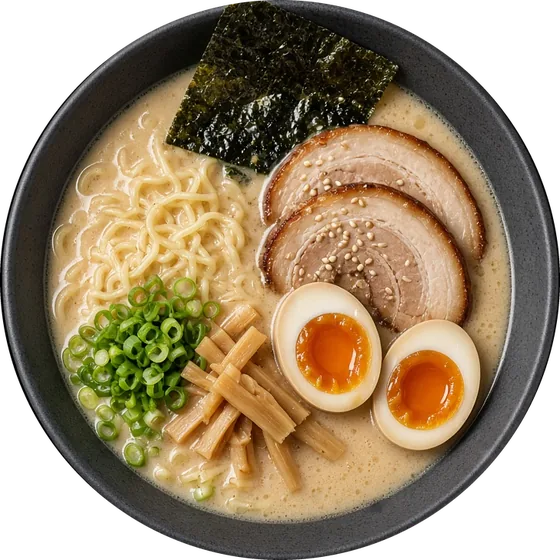
Ramen is a Japanese soup of Chinese-style wheat noodles in a salty broth. The name comes from the Chinese lamian, "pulled noodles".[1][2]
What is in ramen?
- Wheat noodles made with kansui, an alkaline mineral water that makes them longer, yellower and more elastic
- Salty broth
- Soy sauce
- Chashu (Chinese-style roast pork)
- Boiled spinach, fish cake (kamaboko) and seaweed
Where does ramen come from?
Yokohama opened as an international port in 1859 and drew a large Chinese population, who brought lamian noodles to Japan. The oldest record of the name "Nankin soba" dates from around 1884, according to a caption at the Shin-Yokohama Ramen Museum.[3]
In 1910 the Rairaiken opened in Tokyo's Asakusa district and is considered the first restaurant to serve shina soba. Its owner, a former Yokohama customs official, hired thirteen cooks from that city's Chinatown. There the dish was adapted to Japanese taste with soy sauce, chashu, spinach, fish cake and seaweed.[1][3][2]
Older origins do not hold up. A 17th-century legend says Tokugawa Mitsukuni ate noodles seasoned on the advice of Chinese scholar Zhu Shunshui; Tokyo Weekender considers it probably a later invention. The keitaimen noodles eaten in Kyoto in 1488 are not accepted as a precursor of ramen either.[3]
Types of ramen
Instant ramen: in 1958 Momofuku Ando launched the first one, Chikin Ramen, a brick of fried, dehydrated, chicken-flavored noodles.[2]
Iekei, from Yokohama: thick noodles, rich pork-bone broth, soy sauce and chicken fat.[3]
Other names
It was first called Nankin soba and then shina soba, "Chinese noodles". After World War II the word shina became offensive and the dish was renamed chuka soba; over time "ramen" took over. Tokyo Weekender notes that nobody knows who proposed that name, which already existed before the war.[1][2][3]
When is ramen eaten?
It began as laborers' food: fast, salty, cheap and filling. In the 1910s and 1920s, Chinese-style restaurants serving it multiplied in Tokyo.[3][1]
Did you know?
In English, the word "ramen" first appears in 1962, in the phrase "instant ramen noodles".[1]
Momofuku Ando, the inventor of instant ramen, lived to 96 and ate ramen almost every day.[2]
Frequently asked questions
What is ramen?
Ramen is a Japanese soup of Chinese-style wheat noodles in a salty broth. The name comes from the Chinese lamian, "pulled noodles".
What are the ingredients of ramen?
Wheat noodles made with kansui, an alkaline mineral water that makes them longer, yellower and more elastic; Salty broth; Soy sauce; Chashu (Chinese-style roast pork); Boiled spinach, fish cake (kamaboko) and seaweed.
Where is ramen from?
Yokohama opened as an international port in 1859 and drew a large Chinese population, who brought lamian noodles to Japan. The oldest record of the name "Nankin soba" dates from around 1884, according to a caption at the Shin-Yokohama Ramen Museum.
When is ramen eaten?
It began as laborers' food: fast, salty, cheap and filling. In the 1910s and 1920s, Chinese-style restaurants serving it multiplied in Tokyo.
Sources
- Online Etymology Dictionary (cita a Katarzyna J. Cwiertka, Modern Japanese Cuisine): Ramen
- Mental Floss: Discomfort Food: The Strange and Twisted History of Ramen Noodles
- Tokyo Weekender (Cezary Jan Strusiewicz): Ramen by Any Other Name: The Hidden History of Chuka Soba in Japan
Researched and checked on October 14, 2026. Legends and disputed claims are marked as such in the text. How we work
Other dishes
What is curry? · What is a bento? · What is onigiri? · What is oden? · What is a dumpling (jiaozi)? · What is tempura? · What is fried rice (arroz chaufa)? · What is pozole? · What is pan de muerto? · What is a tamale? · all