What is rice and black beans?
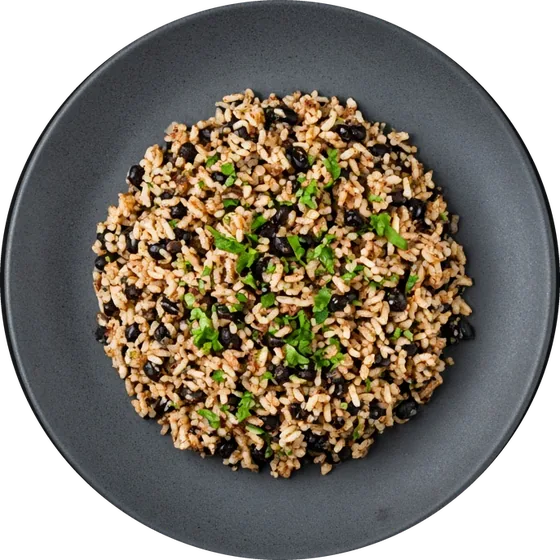
Rice and black beans is rice cooked or stir-fried together with already-cooked beans, onion, garlic and spices. Each country has its own name for it: gallo pinto in Costa Rica and Nicaragua, and moros y cristianos or congrí in Cuba.[3][4][5]
What is in rice and black beans?
- Rice
- Black beans; red beans in Nicaragua
- Onion, garlic, sweet pepper and cilantro
- In Cuba: cumin, herbs and ají cachucha (a mild chili)
- In Limón, Costa Rica: coconut milk and Panamanian chili
- On the side: eggs, fresh cheese, tortillas and ripe plantain
Where does rice and black beans come from?
Beans have been eaten in Central America since before the Spanish arrived; the Spanish planted rice in the 16th century. According to researcher Patricia Vega of the University of Costa Rica, rice became a major part of the diet in the 19th century, with the coffee boom, and the rice-and-beans combination was brought by Afro-Caribbean railroad workers. During the Great Depression the middle class adopted it.[1][2]
Costa Rica and Nicaragua both claim gallo pinto. Both accept its Afro-Caribbean roots, but there is no proof of who made it first. According to Culture Trip, the first written account is in Carlos Luis Fallas's novel Mamita Yunai, where workers from both countries share it on the Caribbean banana plantations.[3][4]
The name gallo pinto ("spotted rooster") is explained by a legend told in both countries: a farmer planned to serve his spotted rooster at a feast, more guests came than expected, and he stretched the meal with rice and beans.[4]
Types of rice and black beans
Costa Rica: in the Central Valley it is moister, with onion, cilantro and chili; in Guanacaste, more toasted and with more lard, without cilantro; in Limón it has coconut milk.[2]
Nicaragua makes it with red beans; Costa Rica, with black.[4]
Cuba: according to the University of Florida, it is called moros y cristianos in the east of the island and congrí in the west. Others, such as chef Aarón Sánchez, use congrí for the red-bean version; for him, in moros y cristianos the rice and beans cook together.[5][6]
Other names
"Moros y cristianos" ("Moors and Christians") refers to the wars between Moors and Christians in Spain: the black beans stand for the Moors and the white rice for the Christians. In Miami, the name took hold in the early 1960s with exiled Cuban cooks from eastern Cuba.[6][5]
When is rice and black beans eaten?
In Costa Rica and Nicaragua it is the traditional breakfast, with eggs, fresh cheese, tortillas and ripe plantain, though it shows up at any meal. In Cuba it comes with boiled cassava topped with garlic, onion and lime.[3][4][5]
Did you know?
In 2003 Costa Rica made 438 kg of gallo pinto in front of Guinness representatives. Two weeks later, in Nicaragua, 15 chefs made 544 kg and took the record. In 2009 Costa Rica answered with a batch to feed 50,000 people.[4]
Frequently asked questions
What is rice and black beans?
Rice and black beans is rice cooked or stir-fried together with already-cooked beans, onion, garlic and spices. Each country has its own name for it: gallo pinto in Costa Rica and Nicaragua, and moros y cristianos or congrí in Cuba.
What are the ingredients of rice and black beans?
Rice; Black beans; red beans in Nicaragua; Onion, garlic, sweet pepper and cilantro; In Cuba: cumin, herbs and ají cachucha (a mild chili); In Limón, Costa Rica: coconut milk and Panamanian chili; On the side: eggs, fresh cheese, tortillas and ripe plantain.
Where is rice and black beans from?
Beans have been eaten in Central America since before the Spanish arrived; the Spanish planted rice in the 16th century. According to researcher Patricia Vega of the University of Costa Rica, rice became a major part of the diet in the 19th century, with the coffee boom, and the rice-and-beans combination was brought by Afro-Caribbean railroad workers. During the Great Depression the middle class adopted it.
When is rice and black beans eaten?
In Costa Rica and Nicaragua it is the traditional breakfast, with eggs, fresh cheese, tortillas and ripe plantain, though it shows up at any meal. In Cuba it comes with boiled cassava topped with garlic, onion and lime.
Sources
- Universidad de Costa Rica, repositorio Kérwá (Patricia Vega Jiménez, Food, Culture & Society, 2012): El Gallo Pinto: Afro-Caribbean Rice and Beans conquer the Costa Rican National Cuisine
- El Observador (Costa Rica): Tasty dedicó un video al gallo pinto costarricense y esto no le gustó a muchos nicaragüenses
- Prensa Latina: Chifrijo
- Culture Trip: Costa Rica vs Nicaragua: Who Really Invented Gallo Pinto?
- University of Florida, Cuban Studies Institute: Not your average congrí
- La Comida del Barrio (Aarón Sánchez, 2003), vía ckbk: Cuban Black Beans and Rice
Researched and checked on October 14, 2026. Legends and disputed claims are marked as such in the text. How we work
Other dishes
What is a pupusa? · What is pernil? · What is arroz con gandules? · What are fried sweet plantains? · What are tostones? · What is mofongo? · What is ropa vieja? · What is pozole? · What is pan de muerto? · What is a tamale? · all